The Kitchen Clinic: 3 DIY Bodywork Hacks Using Household Objects

The Kitchen Clinic: 3 DIY Bodywork Hacks Using Household Objects

During my decades in clinical practice, I often told my patients that the best massage therapist in the world is the one they have at home: themselves. You don’t always need a $200 percussion massager or a weekly standing appointment to find relief from chronic tension.

Sometimes, all you need is a granite countertop, a bath towel, and a “magic” fat Sharpie. Here are three professional-grade techniques to reset your kinetic chain using items you already own.

1. The “Countertop” Hip Reset (TFL & Glutes)

If you’ve read my article on why your IT Band is screaming, you know the Tensor Fasciae Latae (TFL) is usually the culprit. Using a kitchen countertop—granite or marble is best for the “sink”—allows you to use your body weight for deep, clinical leverage.

You know the Sharpie technique but you can use the same technique to address TFL and gluteals with the edge of a countertop. Granite tops are my favorite but just about any counter top will do. The idea is to move your leg outward to slacken the muscles in the side of your hip. Then use the edge and the corners of the counter to dig in to your front, side and back of your hips. This may not work for all people, some may need a very stable, no slip stool and some may need to lean down a bit.

  • The Setup: Stand against the edge of your counter. Move your target leg outward (abduction) to slacken the hip muscles.
  • The Technique: Use the flat edge of the counter for your broader Glute Medius, or the 90-degree corner to dig into the front-side “pocket” of your hip (the TFL).
  • The Clinical Pro-Tip: Some may need a small stool for the non-working leg to get the height right. Lean in and breathe. You are looking for that “bruised golf ball” feeling to melt away.

2. The Spinal Towel Roll (The Tech-Neck Killer)

Forward Head Posture (FHP) and “rounded shoulders” are the hallmarks of the modern office worker. This technique uses gravity to perform a passive stretch on the Pectoralis Minor and the Thoracic Cage.

Bath towels are great too. One of my favorite upper body relaxation techniques is to roll up a towel and lay my spine over the towel. You have to experiment with different towels to see which one feel the best but let me tell you what you are looking for. You’ll want to fatten up the towel a bit in your lumbar region. You want the towel to end at your cervical spine. When you lay face up with the towel supporting your spine you will feel your shoulders want to fall back toward the floor. This is another key ingredient of the right towel. The right towel will not hold your scapulae, or shoulder blades, up; they should fall down creating a stretch in your pectorals. At this time open your arms wide and feel your shoulder blades touch the ground. You may want to tuck your chin down slightly to get a stretch through your neck. This will stretch your thoracic cage, free up your scapula and help reset forward head posture all in one. Amazing!

  • The Setup: Roll a bath towel into a firm “log.” Lay it on the floor and lie down so the towel supports your spine from your lower back to the base of your skull.
  • The Technique: You want enough “fatness” in the towel to support your lumbar curve, but not so much that it’s uncomfortable. Open your arms wide like a “T.”
  • The Goal: Your shoulder blades (scapulae) should NOT be supported by the towel. They should fall toward the floor. This stretches the chest and resets the thoracic spine.
  • The Finish: Tuck your chin slightly to stretch the suboccipital muscles at the base of your neck. Hold for 5–10 minutes.

3. The Table-Edge Forearm Pump

Stiff forearms are the silent driver of “Mouse Elbow” and Carpal Tunnel symptoms. Using a heavy table edge allows for Cross-Fiber Friction—the gold standard for breaking up muscular adhesions.

The next one is for forearm pain. Anyone who types should do these. You’ll want to use a heavy table and with your forearm between you and the edge of the table, palm facing toward you, lean in on your forearm to apply compression and friction to your extensor muscles. Extensor muscles are on the side of the forearm with the back of your hand. Be sure to open and close your hand and feel the different extensor muscles fire. You will feel some discomfort and those are generally the places you should focus on. Areas with discomfort can mean there is adhesion in the extensors be it fascial or muscular. Probably a good time to drink water.
For the flexor muscles in your forearm sit close the 90˚ bend of the table. Flexor muscles are the forearm muscles on the palm side of your forearm. Lift your arm over the bend and rest your forearm, palm down. across the edge of the table. Using the same compression and friction technique you can break up adhesion and pump in fresh healthy blood to your forearm muscles. To finish off your forearms you can use your thumb, or the magic fat sharpie, to compress and friction the small muscles and tendon that are around your inner and outer elbow bone.

  • Extensors (Top of Arm): Face the table. Place your forearm across the edge, palm facing you. Lean in to apply compression and friction. The “MT” Secret: Open and close your hand while the muscle is pinned against the table. You will feel the muscles fire and “release” under the pressure.
  • Flexors (Bottom of Arm): Sit at a 90-degree corner. Lay your forearm across the edge, palm down. Use the same leaning compression to pump fresh blood into the flexor group.
  • The Sharpie Finish: Use the “Magic Fat Sharpie” (or your thumb) to apply pinpoint pressure to the small tendons around the inner and outer elbow bones.

The “Kitchen Clinic” Starter Kit

If you don’t have these items handy, all can be found at your local thrift store.

Spatula Handle

The “Big Fat Sharpie” can be substituted for many things around the kitchen. What you are looking for is the end of a kitchen tool that has a blunt end you can sink into your soreness.

Check Your Drawers

Bath, Hand or Beach Towels

For the spinal roll, you need a towel. The key is to have your spine supported between your shoulder blades. The towel may only need to be 3 inches thick when rolled.

Check Your Linen Closet

Free Section

This article was designed to allow those without the means to purchase massage tools and professional sessions get relief from muscle pain with everyday household goods. Don’t let the simplicity fool you. These techniques work because they follow the same mechanical principles I used in my professional practice. Try them tonight and feel your kinetic chain reset.

Why Your IT Band Won’t Stop Hurting (The TFL Connection)

Stop Rolling Your IT Band! Why the TFL is the Real Culprit

In my years of clinical practice, I have seen hundreds of patients “torturing” themselves on foam rollers, trying to loosen a tight IT Band. If you’ve done this, you know the cycle: it’s incredibly painful, and the relief lasts for about ten minutes before the tension returns.

Here is the clinical secret: You cannot “stretch” or “roll out” the IT Band. The Iliotibial (IT) Band is not a muscle; it’s a thick, fibrous piece of fascia with the tensile strength of soft tissue steel. If you want it to relax, you have to look at the “engine” that controls its tension. You have to look at the Tensor Fasciae Latae (TFL).

The TFL: The Tiny Muscle with a Big Ego

The TFL is a small, teardrop-shaped muscle located on the high-lateral side of your hip, attaching to the ASIS (the bony point at the front of your hip). Its primary job is to assist in hip flexion and rotation.

However, because we live in a “sitting culture,” the TFL is almost always in a shortened, hyper-tonic state. Because it is physically fused to the top of the IT Band, a tight TFL acts like a winch on a Jeep—it cranks the IT Band tight, pulling it across the lateral epicondyle of the knee. That “snapping” or “burning” you feel at your knee? That’s just the symptom. The TFL is the cause.

The “Pocket Muscle” Landmark: How to Find Your TFL Target

To fix the issue, you have to find the right target. Most people look too low on the leg. To find your TFL, put your hands in your front pockets. Where your thumbs naturally rest against the side of your hip—just below that bony “shelf” of your pelvis—that is your TFL.

Still Can’t Find Your Tensor Fasciae Latae?

Sitting in your chair, lift your bent leg slightly up toward the desk. You will feel a piece of muscle pop up on the top of your hip bone. Your TFL is just outside of that muscle that popped up.

The TFL muscle portion attaches along the side-front dip part of your hip bone and goes about 2 inches deep. The TFL muscle then goes down at an angle back to about the top of your leg bone (femur). The muscle then turns to tendon and becomes the Iliotibial band. While the band itself can get stuck and hold trigger points, most times the trigger points are in the TFL muscle itself, which sends referral pain down your IT band.

If you’ve been sitting at a computer all day, pressing into this spot will likely feel like pressing into a bruised golf ball. This is the spot that needs release, not the side of your leg.

The Comfort Trap: Why the TFL Locks Up

This is where my previous articles on Sitting on a Wallet and Sitting on One Leg come into play. When your pelvis is tilted, the TFL on one side is forced into a permanent “crunch.”

Furthermore, the TFL and the Gluteus Medius are supposed to work together to stabilize your hip. However, because our glutes tend to “go to sleep” when we sit, the tiny TFL has to do all the heavy lifting of balancing the weight of your leg. It becomes hyper-tonic (overactive) while the glute medius becomes inhibited. You can’t fix your IT band related knee pain until you level your pelvis and release the TFL engine.

How to Release the TFL: Ischemic Compression

To get a real clinical result at home, don’t just roll back and forth. That just irritates the fascia. Instead, follow these steps:

  • Find the “hot spot” (the pocket muscle) using your lacrosse ball.
  • Lean your weight into it until you feel a “good hurt” (about a 7/10 on the pain scale).
  • Breathe. Hold for 30–60 seconds until you feel the muscle “pulse” or melt.

This is called Ischemic Compression. Ischemic Compression is one way professionals reset a muscle’s resting length and finally allow the IT Band to go slack. While the lacrosse ball is a great way it may not be feasible at the office. In that case pick up a big fat sharpie like this one on Amazon and use it to hold pressure on the tender spot of your TFL. When the tenderness subsides you can use the TheraGun on low to pump in fresh blood.

If you’ve been rolling your leg for months with no relief, it’s time to stop attacking the rope and start addressing the TFL. Your knees—and your lower back—will thank you.


Does Your Car Seat Cause Low Back Pain? How Driving Position Affects Your Spine

Understanding Pain Sources: Why Your Car Matters

Chronic pain rarely starts suddenly. It typically begins as minor discomfort – something you can ignore or work around – until one day it develops into persistent, nagging pain that affects your daily life. The period when you first notice that minor discomfort is actually more important than most people realize, because there’s an associated action or position causing your muscular pain to develop.

The challenge with driving-related back pain is that most of us can’t simply stop driving. We need our cars for work, errands, and daily life. This means we’re repeatedly putting our bodies in the same problematic position day after day, allowing minor discomfort to evolve into chronic pain patterns.

How Driving Position Creates Low Back Pain

When you sit in a car, several factors can stress your lower back:

Seat Angle and Recline

Most car seats position your hips lower than your knees, creating posterior pelvic tilt. This flattens your natural lumbar curve and puts excessive pressure on your lower back discs. Over time, this position can lead to disc compression, muscle strain, and chronic pain.

Leg and Hip Positioning

Your leg position while driving directly impacts your low back position. When your legs are cramped, extended too far, or positioned awkwardly to reach pedals, your pelvis tilts and your spine compensates. This compensation creates muscle tension that builds over weeks and months of driving.

Arm and Shoulder Reach

Reaching too far forward for the steering wheel causes you to round your upper back and shoulders forward, which in turn affects your lower back position. This full-body misalignment creates a chain of tension from your neck down to your low back.

The Size Mismatch Problem

Tall Drivers in Small Cars

If you’re a 6’6″ tall, 270-pound person trying to fit into a compact car, your body simply doesn’t have enough space. Your knees might be jammed against the dashboard, forcing your pelvis into positions that strain your low back. The lack of legroom means you can’t shift positions during long drives, and that static posture creates progressive muscle tension and pain.

Short Drivers in Large Vehicles

On the flip side, a 5′ tall, 100-pound person driving a large SUV or truck faces different but equally problematic challenges. You might need to scoot forward to reach pedals, forcing you to stretch your arms uncomfortably to reach the steering wheel. Or you might slouch down in the seat to get your feet properly positioned on pedals, creating poor spinal alignment that leads to back pain.

Both scenarios create chronic pain because they force your body into unnatural positions that your spine wasn’t designed to maintain for extended periods.

7 Ways to Fix Your Car Seat Position and Stop Low Back Pain

1. Adjust Your Seat Height

Your hips should be level with or slightly higher than your knees. Many modern cars have seat height adjustments – use them. If your car doesn’t have this feature, consider adding a firm cushion to raise your sitting position slightly.

2. Set Proper Seat Recline

Your seat back should be reclined about 100-110 degrees – not perfectly upright (90 degrees) and not reclined like you’re lounging (120+ degrees). This angle supports your lumbar curve while allowing your muscles to relax slightly.

3. Adjust Seat Distance from Pedals

You should be able to fully depress the brake pedal while maintaining a slight bend in your knee (about 120-130 degrees). Your knee should never be completely straight or sharply bent while driving. This position allows proper circulation and reduces hip flexor tightness that contributes to low back pain.

4. Use a Lumbar Support

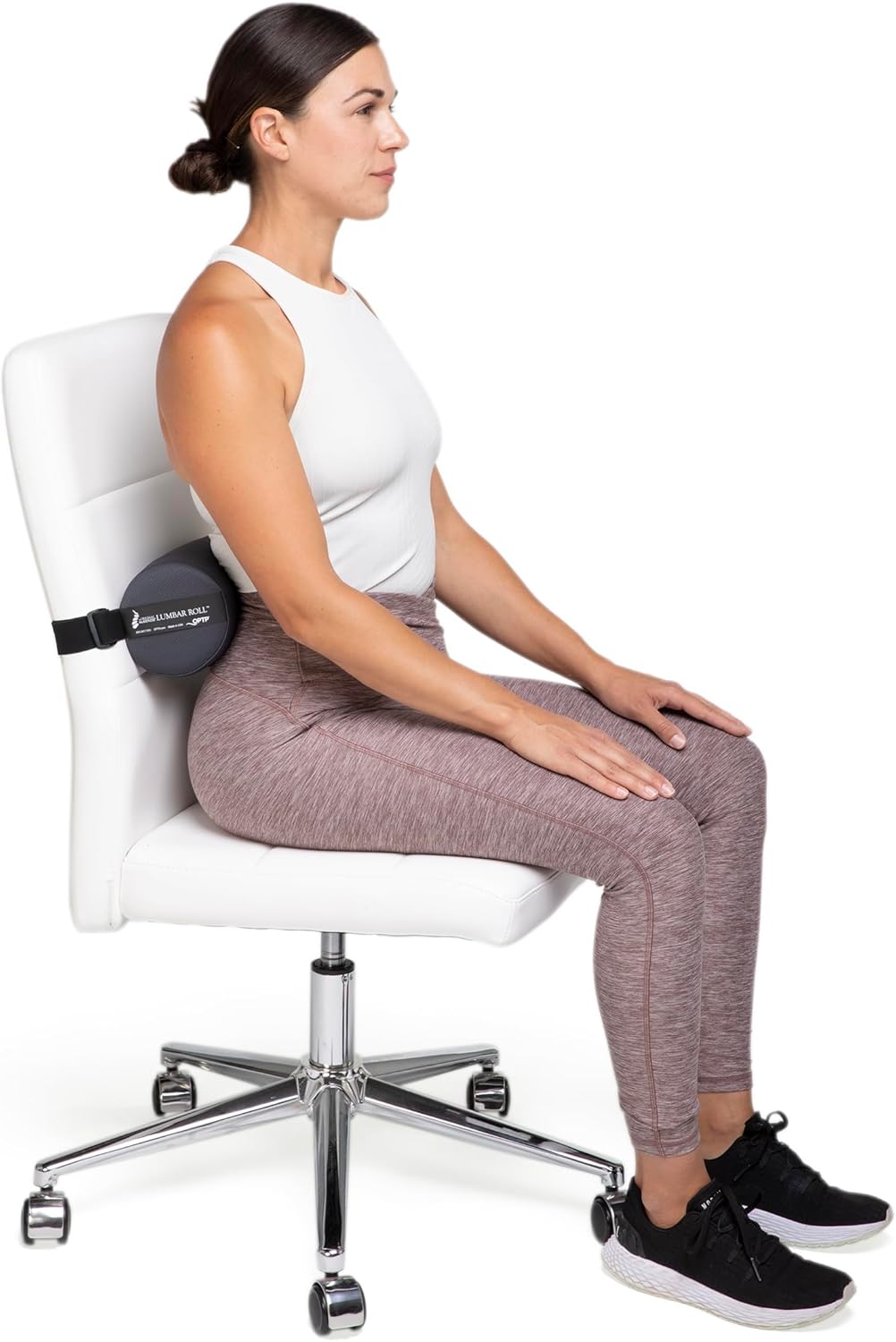
Most car seats don’t provide adequate lumbar support. Adding a lumbar cushion fills the gap between your lower back and the seat, maintaining your natural spinal curve and reducing disc pressure.

5. Position Your Steering Wheel Correctly

Your steering wheel should be close enough that your shoulders stay against the seat back when your hands are at 9 and 3 o’clock. If you’re reaching forward, you’re creating upper back tension that cascades down to your lower back.

6. Take Driving Breaks with Targeted Stretches

For drives longer than one hour, stop every 45-60 minutes to stand, stretch, and walk around for 5 minutes. This breaks up static posture and allows your muscles to reset. Even better – use these breaks to perform specific stretches that target the muscles most affected by driving.
These stretches may not be best if you have specific pain or injury. Always consult the doctor who monitors your back pain.

Standing Quad Stretch

Your hip flexors and quadriceps become shortened and tight from prolonged sitting with your knees bent. Standing quad stretches help restore length to these muscles and reduce the pulling force they create on your pelvis and low back.

How to perform: Stand next to your car for balance. Bend one knee and grab your ankle, pulling your heel toward your glutes. Keep your knees close together and avoid arching your low back. Hold for 30 seconds, then switch sides. You should feel a stretch down the front of your thigh.

Hip Flexor Lunge Stretch

Hip flexors get extremely tight from sitting, pulling your pelvis forward and creating low back compression. This stretch directly addresses one of the main culprits of driving-related back pain.

How to perform: Step forward into a lunge position. Keep your back knee straight and push your hips forward gently. You’ll feel a stretch in the front of your rear hip. Hold for 30 seconds per side. Don’t bounce – use gentle, sustained pressure.

Standing Hamstring Stretch

Tight hamstrings pull down on your pelvis, flattening your lumbar curve. Stretching them during breaks helps restore proper pelvic position.

How to perform: Place one foot on your car’s bumper or running board (or a curb if nothing’s available). Keep that leg straight and lean forward from your hips, not your waist. You should feel the stretch behind your thigh. Hold 30 seconds per leg.

Torso Rotation Stretch

Sitting creates stiffness in your spine. Gentle rotations restore mobility and release muscle tension.

How to perform: Stand with feet shoulder-width apart. Place your hands on your hips and gently rotate your upper body left, then right. Move slowly and deliberately – this isn’t about how far you can twist, but about restoring movement. Perform 10 rotations in each direction.

Cat-Cow Stretch (Modified Standing Version)

This classic yoga movement helps restore your lumbar curve and releases tight back muscles.

How to perform: Stand with hands on your thighs for support. Arch your back and look up (cow position), then round your back and drop your head (cat position). Move slowly between positions 8-10 times. This mobilizes your entire spine.

Pro tip: Set a timer on your phone for 45-minute intervals during long drives. When it goes off, find a safe place to pull over and perform all five stretches. The entire routine takes just 5 minutes but makes a significant difference in how your back feels when you reach your destination.

7. Consider Professional Seat Modifications

For severe size mismatches, a skilled mechanic can sometimes relocate seat mounting brackets backward (for tall drivers) or add pedal extenders (for short drivers). While not feasible for all vehicles, it’s worth consulting a local mechanic if standard adjustments don’t solve your pain.

When to Seek Professional Help

If you’ve optimized your car seat position and still experience low back pain while driving, you may have developed muscular imbalances or trigger points that need professional treatment. As a massage therapist, I regularly treat:

  • Hip flexor tightness from prolonged sitting
  • Piriformis syndrome causing sciatic-type pain
  • QL (quadratus lumborum) muscle spasms
  • Gluteal muscle weakness leading to compensation patterns

These issues often develop from months or years of poor driving posture and may require hands-on treatment to resolve fully.

Fix Your Seat and Drive Out Your Back Pain

Your car seat position matters more than most people realize. Chronic low back pain from driving isn’t just an inconvenience – it’s your body’s warning signal that something in your positioning needs to change. By understanding how your specific body size and car type create pain sources, you can make targeted adjustments that provide real relief.

Start with the seven adjustments listed above. If pain persists after two weeks of optimized positioning, consider consulting a massage therapist or physical therapist who specializes in postural pain to address any muscular imbalances that have already developed.

Your daily commute doesn’t have to come with a side of chronic back pain. Small changes to your driving position can create significant improvements in your comfort and long-term spinal health. Your Spine Will Thank You.

Social Media

In recent years the landscape of social media has changed. What began as a meeting ground for people has turned into a place that is unwelcoming for most.
We believe that is true for StopLowBackPain.com.
Our goal is to provide information outside of the controlled social platforms. If you want to end low back pain, or any kind of physical pain you should not be bound to the terms and conditions of a website. StopLowBackPain.com does not require you to agree to any terms or conditions. All we ask is that you read and enjoy the content. After your read, should you like to, you are welcome to copy the URL link and text or email it to your friends. Likewise, you can share StopLowBackPain.com information on your own social media feed however StopLowBackPain.com will no longer maintain a social media presence.
Additionally we believe social media is an actual contributor to physical pain in many ways. These pain patterns are just becoming evident as phone, tablet and computer time are increasing. Here we will discuss why.

Attention Span

This is not a mystery. Attention span of the average person has diminished to 15-30 seconds because of the way social media operates. This is intentional programmer design. In fact it is easy to find the inventors of social media admitting coding this in. Designing the software to keep you online for longer using shorter “clips” distorts your perception of time. Although it sounds genius this method is not new. Pointing out the not so obvious problem is with a short attention span you may expect your back pain to be gone in 15-30 seconds. Soft tissue thankfully doesn’t respond that quickly which is why you have been able to get away hanging over your phone for so long.

Social Media and Beer Consumption

This same philosophy has been used by professional bartenders for generations. Beer makers too. The pint glass is a traditional way to pour a beer from a tap. However this is not the case for bottled beer. Historically bottled beer would be poured into a much smaller glass. There are multiple reasons for this. For this study it is proven. You will consume more beer from a smaller glass.

But why?

Because the amount of beer in the glass is smaller the human brain thinks the glass is almost empty. So you drink all the beer in the glass because it is such a “small amount”. Then you refill the glass from the bottle. Even though the amount in the glass could be 3 ounces. Break that down you have 4 pours per 12 ounce bottle of beer. As you can see there is a high potential to drink an entire beer in just 4-5 “sips”. If it sounds a little like a set up … it is.
You will also consume beer faster from a smaller glass. It is human nature to take a sip each time you add beer to the smaller glass. Creating basically a constant flow of drink. Once discovered the size of a beer glass changed size and shape.

While this may sound untrue I encourage you to try it. Get a beverage, doesn’t have to be beer, and pour it into a smaller glass than normal. See if you can find about a 6 ounce glass and test this for yourself.

Social Media and Static Positioning

Another negative with social media is static positioning. Static positioning is when your body is in the same position for extended periods of time. The human body is meant to move almost constantly when not in a sleep cycle. That means if you are awake you should be moving. Previously the personal computer was pretty bad but now with most computer use being through a phone it’s worse.

When using a phone to access social accounts the device is so small that it forces your body into a collapsed position. At this moment, in this small website, these are pioneering statements for the upcoming generations. Very soon you will see adults with humpbacks, breathing issues from collapsed posture, severe headaches….I could go on and on. Mainly focus on the fact that we really don’t know what adverse effects we will see from generational social media use. As of now kids being raised with tablets to keep them occupied. Seeing the true effects of generations of social media is still about 10-15 years away. Stay Tuned!

Now static positioning has been brought to your attention. Call it sitting in one place for too long. Commonly it will be when you are charging your phone that static positioning will be at its worst. Be sure to have a long charging cord and not stay too hunched over for an hour. More importantly, share the information you learned here. 🙂

Clinical Massage To Reduce or Eliminate Low Back Pain

Can you use Clinical Massage To Reduce or Eliminate Low Back Pain? The short answer is yes but you need to make sure you’re seeing a clinical focused professional.

Commonly low back pain sufferers will try massage to help alleviate low back pain. However the average massage that you will book will not have a clinical focus. Before you book your next session spend just a bit of time looking through this site and understanding what causes your back pain specifically. Once you have a good idea of what a self-diagnosis looks like for you, discuss your self-diagnosis with the clinical therapist you are booking a session with. He or She will be happy to discuss your pain patterns and what exactly may be causing the discomfort and more importantly what you can do about your unique low back pain situation.

Questions To Help You Find A Good Clinical Massage Therapist

While seeking a practitioner to properly address low back pain, ask these questions. These question wil help you find a good clinical massage therapist to reduce low back pain.

1.) Can we spend the hour massage on just my low back, hips and thighs?

Why: A clinical massage therapist will have no problem spending an hour addressing your low back, hips and thighs. Furthermore, the reason I mention low back, hips and thigh areas is they all attach to your pelvis. Altogether focusing on this area will begin decompression which could help reduce low back discomfort. Possibly during the first session. A good clinical massage therapist will be able to adjust the length of time he/she will be working on any part of the body. Even just your hands and forearms. A good clinical therapist will be able to spend a whole hour on just your forearms and hands.

2.) Do you use Myofascial Techniques?

Why: Myofascial Techniques are preformed without oil at a very slow pace. Fascia encases all of the muscles and organs of your body. Fascia also has thixotropic properties that will greatly aid in allowing muscles to relax. In fact, not just your muscles but the fascia itself can be “stuck” or “adhered” which will limit range of motion and lead to pain.

3.) I was reading about “Postural Imbalance” and didn’t quite understand completely. Can you tell me a little more?

Why: A Clinical Massage Therapist will have a complete understanding of Postural Imbalance and be able to explain how it could be contributing to your low back pain.

4.) I read that muscles in my hips could be contributing to my low back pain, if that is true can you tell me how?

Why: Clinical Therapists understand how muscles relate to each other. A common misconception among those suffering from low back pain is that there is no relation between your low back, hips, stomach muscles and thighs. However, what is called “Referral Pain” quite possibly could be one of the compound factors causing you low back pain.

5.) Do use a lot of oil during your massages?

Why: Using massage oil will prevent the therapist from getting good engagement. That means most of the force applied is lost when attempting deep work. The truth is, if your goal is to stop low back pain, oil should only be used at the very end of your massage session. Massage techniques with oil during a Myofascial massage session will only be used to “smooth out” the specific work applied to your body.

~I already tried massage and it didn’t work.

Commonly people looking to stop low back pain will say “I already tried massage and it didn’t work”. When I hear this statement I know that they did not find the correct therapist. Using the questions above will help you find a therapist that specializes in pain reduction not relaxation.

Relaxation massage will not stop low back pain. Ever.

Relaxation massage or the classic full body massage you will get at most spas, massage practices or chiropractors is not the same as a clinical massage from a therapist who is trained on muscle function. By understanding the function of the human musculoskeletal system a clinical massage therapist will be able to do what is called a “Posture Analysis”. A clinical massage therapist will also address fascia. Fascia is a connective tissue that encompasses the whole body internally. To learn more about Fascia take a look at this article. Just understanding and working with the fascia will make great strides in reducing low back pain.

Additional Pain-Another Common Misconception

Another misconception that I run into all the time is that a massage should hurt in order to be effective. This is not necessarily true and could exacerbate your low back pain. When you choose a competent clinical massage therapist he/she will sufficiently “heat” your skin, fascia and muscle before any specific work starts. Thus the discomfort you feel during your massage should be very very specific. The therapist should be able to let you know you may experience mild pain. Deep pain during clinical massage should be reserved for after the tissues are “heated”.

Being Overweight Causes Low Back Pain

Being Overweight

If you are overweight you can bet that is a contributing factor. People that are overweight are more prone to bad posture because of the areas where the additional weight collects. Indeed I understand how difficult it is to maintain weight in todays world. Fast food coupled with a nutritional pyramid that focuses on carbohydrates and sedentary lifestyles literally make you fat. I won’t go too far into your weight because I know everyone tells you that. Given these points, just do what you can to reduce your weight and you will moving in the right direction to stop low back pain.

Dehydration Causes Low Back Pain

Drinking Water Helps Stop Low Back Pain

The Water-Spine Connection You’re Ignoring

If you’re experiencing chronic low back pain and you’re not drinking enough water, you’re overlooking one of the simplest – and most overlooked – contributing factors to your discomfort. This might sound like an oversimplification, but the connection between hydration and spinal health is backed by anatomy and physiology.

Your intervertebral discs – the cushions between your vertebrae that absorb shock and allow movement – are composed of 70-80% water. When you’re chronically dehydrated, these discs lose water content, becoming less flexible and less effective at cushioning your spine. Over time, this dehydration contributes to disc compression, reduced shock absorption, and the kind of persistent low back pain that seems to have no obvious cause.

Why Your Discs Need Water

Understanding how your spinal discs function helps explain why hydration matters so much. Each disc has a gel-like center called the nucleus pulposus, which is primarily water. This water-rich center acts like a shock absorber, distributing pressure evenly across your spine when you move, bend, or lift.

Throughout the day, as you move and your spine bears weight, your discs compress and water is gradually squeezed out. During rest – particularly when you sleep – properly hydrated discs reabsorb water through a process called imbibition. This nightly rehydration is essential for maintaining disc height and function.

When you’re chronically dehydrated, your discs can’t fully rehydrate overnight. The nucleus pulposus becomes desiccated (dried out), reducing the disc’s ability to absorb shock. This creates a cycle: dehydrated discs compress more easily, which increases pressure on surrounding structures (nerves, joints, muscles), which creates pain and inflammation.

What Actually Counts as Hydration

Over my years as a massage therapist treating chronic pain patients, I’ve heard countless clients claim they “stay hydrated” by drinking “fluids.” Let me be direct: not all fluids hydrate your body equally, and some actively work against proper hydration.

Coffee: The Hydration Debate

Coffee is a diuretic, meaning it increases urine production and can lead to fluid loss if consumed in large quantities without adequate water intake. While moderate coffee consumption (1-2 cups) doesn’t necessarily cause dehydration in regular drinkers, relying on coffee as your primary fluid source is problematic.

The bigger issue with coffee isn’t just the diuretic effect – it’s that people often drink coffee instead of water, not in addition to it. If you’re drinking three cups of coffee but no plain water, you’re missing opportunities to properly hydrate your body and, by extension, your spinal discs.

Soda: Why It’s Terrible for Hydration

Soda is one of the worst choices for hydration, and I’m not just talking about the sugar content (though that’s certainly a problem). During my time working with beverage manufacturing, I learned something most people don’t know: soda is so acidic that the aluminum lines carrying it through bottling plants must be replaced every six months because the soda corrodes them. Not for sanitary reasons – for structural integrity. The acidity literally eats through the metal.

If soda can corrode aluminum, what do you think it’s doing inside your body? The high sugar content causes blood sugar spikes that trigger hormonal responses affecting how your body processes and distributes water. The phosphoric acid in many sodas has been linked to reduced bone density. And like coffee, people often drink soda instead of water, creating a hydration deficit.

The Pure Water Principle

Here’s my stance, and I know some people find it extreme: water is water. The moment you add anything to it – flavoring, sweetener, carbonation, tea leaves, coffee grounds – it’s no longer pure water, and your body has to process those additives.

This includes the trendy water flavor packets, vitamin waters, and “enhanced” waters marketed as healthy alternatives. While these might be better than soda, they’re still not optimal for cellular hydration. Your body processes pure water most efficiently. Everything else requires digestion, filtering, or metabolic processing that reduces the hydration benefit.

Even naturally-flavored sparkling water, while better than soda, isn’t the same as still, pure water for hydration purposes. The carbonation can cause bloating and may reduce how much you’re willing to drink. If you need flavor to drink more fluids, that’s better than drinking nothing – but recognize it’s a compromise, not optimal hydration.

How Much Water Do You Actually Need?

The old “eight glasses a day” rule is outdated and doesn’t account for individual needs. Your actual hydration requirements depend on your body weight, activity level, climate, and overall health.

A better guideline: Aim for half your body weight in ounces of water per day. If you weigh 160 pounds, that’s 80 ounces (about 10 cups). If you’re active, live in a hot climate, or have back pain, consider increasing this to 60-70% of your body weight in ounces.

Signs you’re not drinking enough water:

  • Dark yellow urine (should be pale yellow to clear)
  • Infrequent urination (less than 4-6 times per day)
  • Dry mouth, lips, or skin
  • Afternoon fatigue or headaches
  • Increased low back pain, especially in the afternoon
  • Muscle cramps or joint stiffness

Why Water Quality Matters

Not all water is created equal. The source, mineral content, and purity of your water can affect how well your body absorbs and utilizes it for cellular hydration.

If FIJI is outside your budget, focus on drinking more of whatever clean water you have access to. The most important factor is drinking enough water consistently – the source matters, but volume and consistency matter more.

Practical Strategies to Drink More Water

Knowing you should drink more water and actually doing it are two different things. Here are strategies that work:

Start Your Day with Water

Drink 16-20 ounces of water within 30 minutes of waking up. Your body is naturally dehydrated after 6-8 hours of sleep, and your discs need to rehydrate. This morning water intake kickstarts the disc imbibition process and sets a hydration baseline for the day.

Use Time-Based Reminders

Set hourly reminders on your phone to drink water. When the alarm goes off, drink 8-10 ounces. This creates a consistent habit and ensures you’re spacing out your water intake rather than trying to drink large amounts all at once (which your body can’t absorb efficiently).

Tie Water to Existing Habits

Drink a full glass of water before each meal, after using the bathroom, or whenever you pour coffee. Linking water intake to actions you already perform daily makes the habit automatic.

Track Your Intake

Use a marked water bottle that shows ounce measurements. Seeing your progress throughout the day provides motivation and accountability. Apps like WaterMinder or Plant Nanny can gamify the process if you respond to digital tracking.

Adjust for Activity and Climate

On days when you exercise, work in the heat, or spend time outdoors, increase your baseline water intake by 20-30%. Your body loses more fluid through sweat and respiration, and your discs need that extra hydration to compensate for increased demand.

When Hydration Alone Isn’t Enough

Dehydration is rarely the sole cause of chronic low back pain – it’s a contributing factor that compounds other issues. If you’ve been chronically dehydrated for months or years while experiencing back pain, simply drinking more water won’t immediately fix disc damage or muscular imbalances that have developed.

As a massage therapist, I regularly work with clients whose low back pain has multiple contributing factors. Dehydration might be one piece, but they might also have:

  • Tight hip flexors or hamstrings pulling on the pelvis
  • Weak core muscles failing to support the spine
  • Poor posture creating chronic compression
  • Previous injuries that never fully healed
  • Disc degeneration beyond what hydration alone can address

Increasing your water intake should be part of a comprehensive approach to back pain management, not a standalone solution. But it’s an easy, inexpensive intervention that often yields noticeable improvement within 2-3 weeks of consistent hydration.

Start Hydrating Your Spine Today

Your spinal discs depend on consistent, adequate hydration to function properly. When you’re chronically dehydrated, you’re essentially starving your discs of their primary structural component, leading to compression, reduced shock absorption, and increased pain.

Start today with three simple actions: drink 16-20 ounces of water when you wake up, calculate your target daily water intake based on your body weight, and set hourly reminders to drink throughout the day. Give it two weeks of consistent effort before evaluating whether hydration is making a difference in your back pain.

The science is clear: your discs need water to maintain their cushioning function. The question is whether you’ll provide it. Your Spine Is Thirsty – Give It What It Needs.

Related Articles on Low Back Pain Causes

Dehydration is just one of many factors that contribute to chronic low back pain. Explore these other common causes:

Sitting On One Leg Causes Low Back Pain

Sitting on One Leg: The Hidden Habit Destroying Your Pelvic Alignment

Sitting on one leg is another very common cause of low back pain. Especially in women. Folding a leg between your thigh and the chair seat also causes the same pelvic deviation as mentioned above. At first you may think sitting this way is more comfortable for you. However with the increased number of hours people are sitting at the computer the deviation created is very dangerous. Even if you switch between the left and the right leg.
The compression you are putting on your discs is multiplied far beyond normal. Then you “Switch” and amplify the compression to the opposite side. When you sit at the computer be sure to keep your feet flat on the floor. Better yet take a look at a footrest. There are multiple designs to choose from. I would recommend one that moves easily so you will be inclined to move your legs throughout your workday.


In my time of clinical practice, I’ve noticed a specific pattern of hip tension that almost exclusively affects people who ‘tuck a leg’ while working. I call it the Tucked-Leg Trap.

When you fold one leg under your thigh you are forcing your pelvis into a sustained, aggressive rotation. This creates a massive imbalance in the Psoas and Piriformis muscles. At first, it feels comfortable because you are ‘locking’ your joints, but over time, this habit creates a Pelvic Deviation that forces your lumbar discs to compress unevenly.

The Switching Myth: Many patients tell me, ‘I switch legs every 20 minutes to balance it out.’ Clinically speaking, this is actually worse. Instead of one side being tight, you are now creating a ‘shearing force’ on the sacroiliac (SI) joint, irritating the nerves on both sides.

The only clinical solution is to keep your feet flat, or better yet, use an Active Footrest that encourages movement while keeping your hips level.

Adjustable Under Desk Footrests

The “QL Crunch”: Why One Side Always Aches

When you tuck a leg, you are performing what therapists call a “hip hike.” This puts the Quadratus Lumborum (QL)—a powerful muscle that connects your lower ribs to your pelvis—into a constant state of contraction. This habit creates a Pelvic Deviation similar to what happens when you sit on a thick wallet, but with the added complication of muscular shortening.

On the tucked side, the QL becomes short, tight, and “angry.” On the opposite side, the muscles are overstretched and weak. This muscular tug-of-war is why you feel that deep, dull ache right at the top of your waistline after a few hours at the computer. You aren’t just sitting; you are “training” your muscles to hold your spine in a curve.

The Comfort Trap: Why Your Brain “Likes” This Position

If sitting on one leg is so bad, why does it feel so good? It’s because of Joint Locking. When you tuck a leg, you “lock” your SI joint and your hip into a stable, bone-on-bone position. This allows your core muscles to completely relax.

Essentially, you are using your skeleton to hold yourself up because your postural muscles are tired. While it feels like “rest,” you are actually placing the entire weight of your torso directly onto your spinal discs and ligaments instead of letting your muscles support you.

Clinical Self-Check: The “Level Pelvis” Test

If you’ve been a “leg-tucker” for years, your pelvis might feel “level” to you even when it’s tilted. To reset your body awareness:

Sit in your chair with both feet flat on the floor.

Place your hands on the bony points of your hips.

If one hand feels significantly higher or more “forward” than the other, your muscles have already begun to shorten.

The Fix: Beyond using a footrest, you must “re-train” your nervous system to accept a level pelvis. Every time you feel the urge to tuck your leg, it is a signal that your core is tired. Instead of tucking, stand up, take a 30-second walk, and reset.


Sitting On A Wallet Causes Back Pain

Sitting On A Wallet Causes Back Pain

Sitting on a wallet is a sure fire way to exacerbate low back pain. Moreover is the wallet is jam packed with 3 inches of useless paper. There is absolutely no good reason to have a wallet that is inches thick. With mobile devices being what they are today anything you have stored in your wallet can be entered into your mobile device.
A thick wallet causes low back pain because the wallet pushes up on your hips unevenly. An uneven pelvis is called a Pelvic Deviation. Pelvic Deviation causes the lower lumbar vertebrae to be off center either left or right. The deviation causes low back pain because it will cause the soft fluid discs to become impinged. The impingement is what causes the pain because the nerves from your spinal cord exit between the vertebrae and the disc. Nerve impingement = pain. It’s just that simple.

In my years as a clinical therapist, I’ve seen hundreds of patients walk into my office with a slight ‘hitch’ in their gait (walk) and a tilted pelvis (usually forward and/or twisted). Sitting on a wallet is a sure-fire way to exacerbate low back pain, especially if that wallet is jam-packed with 3 inches of useless paper. There is absolutely no clinical reason to carry a wallet that thick anymore.

If for any reason you need a higher level of medical education to confirm; here is a video from Dr. Nabil Ebraheim confirming that you should pick up some RFID Sleeves, ditch your wallet and your back pain.

Front Pocket Wallets With RFID Technology

The Expert Edit: “The 3-Inch Obstacle to a Pain-Free Spine”
Headline: Fat Wallet Syndrome: Why Your Back Pocket is Killing Your Spine (and How to Fix It)

The Body:
“In my two decades as a clinical therapist, I’ve seen thousands of patients walk into my office with a slight ‘hitch’ in their gait and a ’tilt’ in their pelvis. Often, before I even touch their back, I look at their pants.

If you are sitting on a 3-inch stack of leather, receipts, and old business cards, you are carrying a spinal disaster.

The Clinical Reality of ‘Pelvic Deviation’
When you sit on a wallet, you are essentially forcing one hip to sit higher than the other. In clinical terms, we call this Pelvic Deviation. This uneven foundation forces your lower lumbar vertebrae to shift off-center to compensate.

Think of it like the foundation of a house. If one side of the foundation is three inches higher, the rest of the house has to bend to stay upright. In your body, that ‘bend’ happens at the soft, fluid-filled discs between your vertebrae.

This nerve impingement is what causes that familiar shooting pain, numbness, or ‘electric’ feeling down your leg. It’s not just a backache; it’s a structural crisis.

The 2026 Solution: Digital & Minimalist
There is absolutely no reason to carry ‘inches’ of paper anymore. Between mobile payments like Apple Pay and digital insurance cards (should be in your glovebox anyway), your wallet should be as thin as your smartphone. Thinner.

My clinical advice: Switch to a Front Pocket Wallet if you’re fancy or just the RFID sleeves. Moving your essentials to your front pocket keeps your ‘sit bones’ level and removes the pressure from your sciatic nerve immediately.

Below are the three styles I recommend to those who are serious about ending back-pocket sciatica.”


More Clinical Insights on Posture & Pain from StopLowBackPain.com

Assessing Low Back Pain Effectively

Assessing Low Back Pain

Assessing Low Back Pain
Above all to stop low back pain you must begin assessing low back pain. It should be noted that assessment is much easier than you think. In this article I will outline way to help you assess the cause of your low back pain. By incorporating the suggestions here you will begin to gain a clearer understanding of the root cause of your low back pain.

Stop Saying My Back Hurts

The statement “Stop Saying my Back Hurts” may seem ridiculous however it is part of assessing low back pain. Albeit true, try being more specific with yourself. Replace the above statement with What Am I doing right now? Then assess your current activity. Are you sitting on one leg? Do you still have that bulky wallet? Are you sitting in a poor quality seat? Once you have an answer to the above questions there is yet another question.

What Can I Do To Correct It?

Take action immediately by asking yourself “What can I do to correct it?”. Then do it. For example, throw that wallet away and get a front pocket wallet. If you’re sitting in a poor quality, unsupportive seat, stand up or move to a different seat. While the pain may not immediately subside, identifying the contributing action and correcting it will put you on the correct path. Moreover try not to get angry when you feel your low back pain.

Anger Increases Your Low Back Pain

A common reaction to low back pain is anger. Unfortunately, pain does not correct itself because you are angry. Quite the opposite actually. When you are angry your muscles will naturally begin to tense up. Thus, anger increases your low back pain. Additionally, muscle has memory. So if you are angry at the low back pain you feel you are actually training your muscle to increase tension when you are angry.
How counterproductive is that!

Here is an example to help you get a clear picture. Think back to a repetitive motion job you did. It could be stuffing envelopes to filling jars. Any repetitive job in your past. Do you remember how the first couple times you fumbled around a bit? Then after 15- 20 minutes you seemed to be able to do the job without thinking? That experience was muscle memory at work. In that situation you literally programmed your muscles to know the exact distance to reach to grab the paper and stuff the envelope. Similarly, your back muscles can have this reaction.

Chatuchak Market Vacation Back Pain Causes
Chatuchak Market, Thailand. The juggernaut weekend market that cause my back pain to creep up.

My Process Of Assessing Low Back Pain (This really happened!)

Here is an example of my process for assessing low back pain when it creeps up on me. I’m on vacation in Thailand. We had just walked the better part of the afternoon around Chatuchak Market in Bangkok. The place is massive. Not only did we walk all afternoon but we took public transportation back to the hotel. That means more standing because the train was packed. Then my back pain started. Dull at first but began increasing pretty quick.

I paused and began to “feel” around for a cause. I know we had walked far but I had on Keen sandals which normally give me great support. Plus me feet didn’t hurt, neither did my knees. So I moved on to my hips. Ah ha! I could feel my hips were super tense. Being on the train I was able to hold onto a grab bar and stretch out my hips pretty nicely. I held the stretch on each side for a good 30 plus seconds and did that three times per side. I looked a little funny but whatever.

Again, the pain didn’t go away instantly but I was able to feel it subside rather quickly. When we stepped off the train I was able to walk easier. Also, while standing waiting for cross walks I stretched my hips again, however not as intense. By the time we hit the restaurant I was feeling much better. This is the power of assessing low back pain, without anger, at work.

Applying This Example To Your Self Assessment

In your case you may not stop at your hips. The cause of your pain may be a little higher. Regardless the assessment process is the same. “Feel” each part of your body and analyze what you are doing that is causing the pain. Refrain from anger if at all possible. Then incorporate a stretch to help alleviate the pain. The stretch can be something as simple as a Pelvic Tilt or standing up and taking a short walk using long strides. Whatever the fix is for you the goal is to identify it and take immediate corrective action.